

After the cabinets, countertops are the decision our clients agonize over most. And almost everyone arrives with some version of the same question: quartz or quartzite? Marble or granite? Which one is actually better?
The honest answer is that none of them is better. They’re different materials with different personalities — and the right one depends far less on the stone than it does on how you actually live in your kitchen.
First, the real difference
Natural stone comes out of the ground. Marble, granite, quartzite, soapstone, limestone — it’s quarried, cut into slabs, and finished. Every slab is one of a kind, because it’s a piece of the earth.
Engineered stone — what most people just call quartz — is manufactured. Crushed natural quartz is combined with resin and pigment, then pressed into slabs. It’s a genuine stone product, just a man-made one.
That single difference drives almost everything else.
Uniqueness vs. predictability
With natural stone, you go to the stone yard and choose your actual slab. You see the veining, the movement, where the color shifts and where it goes quiet. Nobody else will have your counters.
That also means a four-inch sample tells you very little. You have to look at the whole slab.
With quartz, you’re choosing a product rather than a piece. The sample you hold is what arrives. The pattern is consistent, the color is predictable, and the slab you order in January matches the one you fell for in October.
Neither is the right answer. Some clients fall in love with one specific slab the moment they see it. Others are genuinely relieved to know exactly what’s showing up on install day.
The maintenance conversation
This is where we have the real talk, because it’s the part people wish someone had told them.
- Marble is beautiful, and it’s soft. It etches — lemon juice, wine, vinegar, even some cleaners will leave a dull spot where the acid eats through the polish. It stains if something sits. Sealing helps with staining, but sealing does not stop etching.
- Granite and quartzite are considerably harder. Quartzite especially — it’s dense and tough, often looks a great deal like marble, and behaves far better. It still wants to be sealed.
- Quartz never needs sealing and resists stains better than anything else we use. Its weakness is heat: the resin can scorch or discolor, so hot pans belong on a trivet, not on the counter.
The question I ask every client is simple: if you found an etch mark on your island six months from now, would it bother you?
If the answer is “that would drive me crazy” — marble isn’t your stone, no matter how much you love how it looks. If the answer is “honestly, I’d kind of like that it looks used” — marble will age beautifully for you and you’ll never regret it.
There’s no wrong answer. There’s only knowing which one you are.
What natural stone lets you do
One thing worth knowing: with real slabs you can do things with veining that a repeating pattern simply can’t.
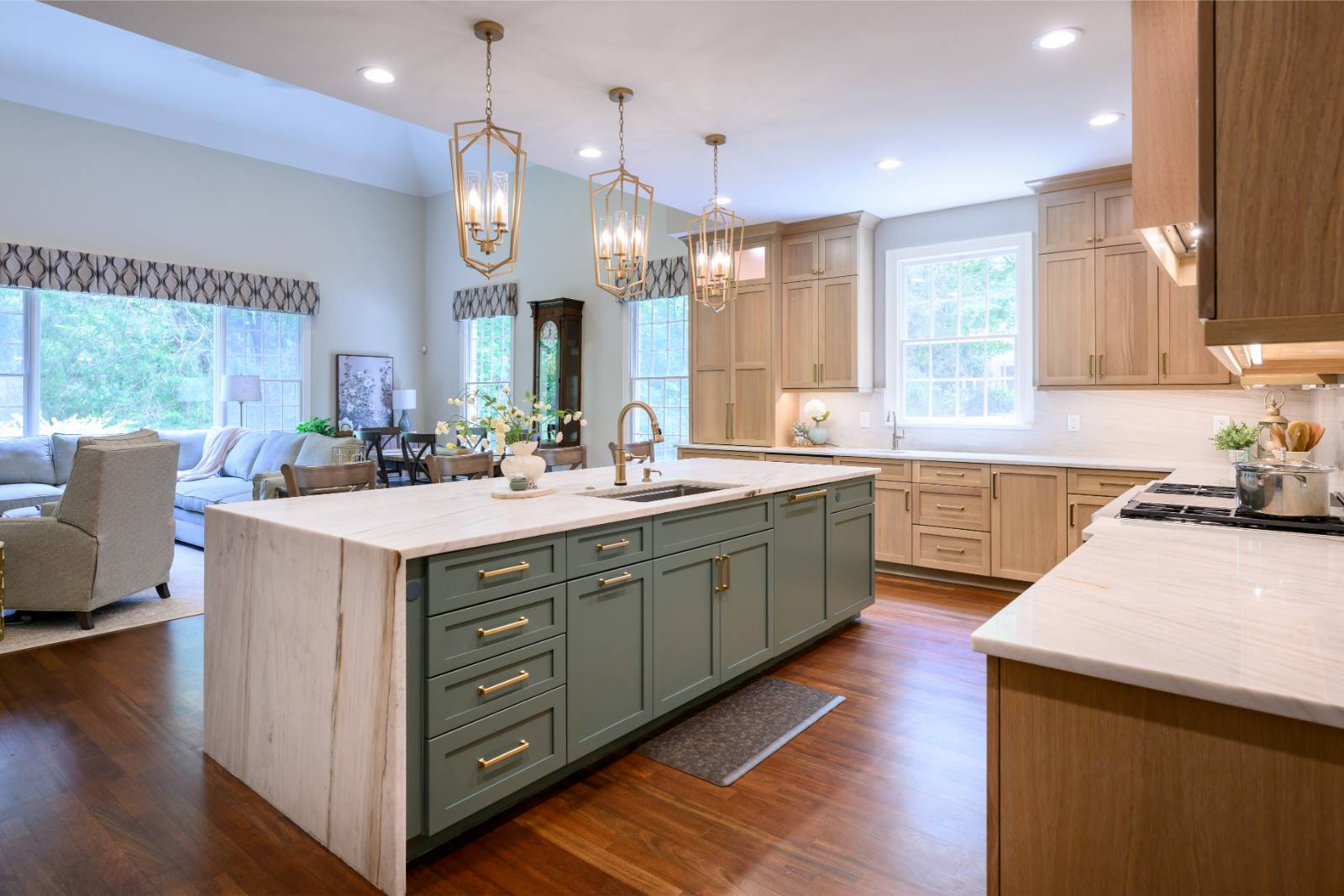
In our white oak and green island kitchen, we ran the same quartzite from the island up the wall as a full-height backsplash — and the veining lines up with the waterfall edge across the room. The whole thing reads as one continuous piece of stone. That only works when you’re laying out real slabs.
Book-matching — two slabs mirrored so the veining opens like a butterfly — is the same idea. It’s a natural-stone move, and it’s worth the effort when the stone deserves it.
How we actually narrow it down
Four questions, and notice how few of them are about stone:
- How do you really cook? Heavy, daily, messy cooking pushes toward quartzite or quartz.
- Who else uses this kitchen? Kids and teenagers change the answer.
- How do you feel about patina? Some people love a surface that shows its history. Some people really don’t.
- Where is it going? A perimeter run takes far more abuse than an island. Plenty of our kitchens use different stone in different places for exactly that reason.
Then we go look at slabs. Same as with choosing a cabinet white — nothing gets decided from a photo.
See it in our kitchens
- Quartzite, used like art. The white oak and green island kitchen — one stone, island to backsplash, veining continuous across the room.
- Marble, for people who want the real thing. In this walnut island kitchen, natural marble runs full height behind the range and carries across the counters.
- Engineered quartz, working hard. In this alabaster kitchen, quartz gives a busy family a bright surface with none of the upkeep worry.
- A bold natural stone as the whole story. Our sage-green island kitchen leans on a deeply veined green marble as the focal point.
The takeaway
If you want a surface you’ll never think about again, engineered quartz is hard to beat. If you want something with real character that will pick up a little history along the way, natural stone is worth every bit of the care it asks for. And if you want the look of marble with the toughness of granite, quartzite is the one most people haven’t heard of and should have.
Still deciding? That’s a good conversation to have in person, with samples in hand. Take a look at our kitchen remodeling and custom cabinetry work, or book a design consultation and we’ll walk through it together.